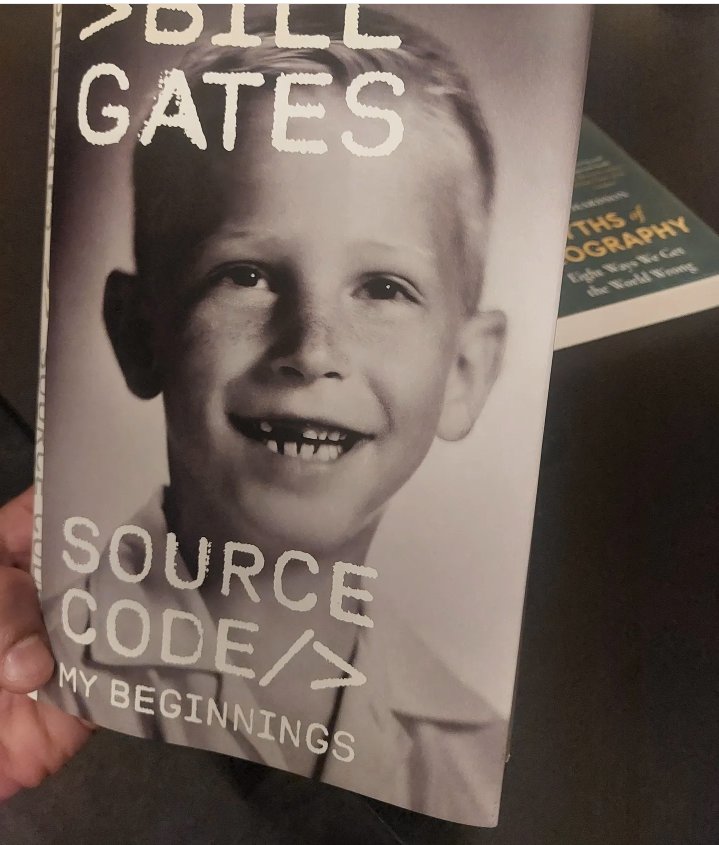
The curious case of one Mr.Bill Gates
Few public figure’s image has changed more dramatically in my lifetime than Bill Gates’. When I was a kid in the ‘90s, Gates was the almost cartoon stereotype version of a big bad capitalist.
He was a ruthless tech mogul, notorious for aggressive business tactics, steamrolling competitors, and building an inescapable Windows empire where you HAD to use Internet Explorer. As Microsoft fought the Justice Department’s massive antitrust case, they became the poster child for cutthroat capitalism with Bill Gates as villain-in-chief.
Fast forward to today and he is the button-down sweater wearing grandpa championing global health and saving the world’s children with malaria nets and early childhood vaccines.
Between these two caricatures lies the real man—a flesh-and-blood person. A person old enough to look back, reflect on his past, and understand the impact of his choices.
That person wrote Source Code.
The Beginning and the End: Where Bill tells stories he clearly enjoys more than I did
I think the first part is ok, but boring (for me). A trip down memory lane of growing up in an reasonably affluent family in post-world war America. The wise old grandma, the lawyer dad, the driven mom, the postcard-from-the-1950’s social life. This nostalgia section was breezy and easy to read but that’s about it.
I might as well tell you that I didn’t take much from the last third of this book either. He’s a smart, driven 19-20 year old who has started Micro-soft (soon changed to Microsoft) with his buddy from high school, Paul Allen. He’s left Harvard. He sounds like he was a pain in the ass and he has the absolutely correct and visionary idea that software for computers, especially computers that everyone will use personally, is the future. Computers were going to be more than the giant hulking machines used in fancy labs and universities and companies. And he (i.e., Microsoft) was going to build software for it. A very far-reaching thought. It’s amazing to see with hindsight how correct he was and how he made the right bets. But not only did he make the right bet, he also executed. Because that matters. Lots of other companies were making bets on personal computers in the early 1970s – the three biggest personal computers of that time were made by Commodore, Apple, and RadioShack’s. We only know about one of those today. .
They let kids do what in the 1960’s?
But the middle part is incredibly interesting. This is where you see all the unique experiences that he got to have that melded with the smart, driven personality that was Bill Gates.
I’m not sure whether something like that would even be possible today. Maybe it’s a testament to the way kids were treated both by parents and by schools and adults in the 1960s. Maybe it’s just his parents and the particular school he went to.
In this section, an intelligent, precocious kid gets sent to a private school that, in the late 1960s, has access to a computer. And there is a group of computer nerds that get together and learn all about computers. They learn to code.
At 13, Gates was already working on testing a set of computers and software for a new venture called C-Cubed that was started by one of the ladies who used to drive them to school as part of the parent carpool. Imagine starting a company today and asking a 13-year-old and his school buddies to come by and help you stress test the technology.
By 15, this group of nerds (the Lakeside Programming Group – named so that they sound professional but really just the name of their high school, Lakeside) secured a contract to develop a payroll system for a company in Oregon. Gates would sneak out at night to program at the University of Washington lab. That is, go to bed, then sneak out of the window, take the night bus to the university and go work in the computer lab. At 15.
When the software program they were writing for the Oregon company was ready, they took the bus down to Portland in order to submit their software. The company welcomed them, they presented the software, they spent the day meeting with executives of the company and even got taken out to lunch at a fancy place. Imagine a company treating a bunch of 15-year-olds that way. Crazy!
The same group was hired by the school to create software to figure out class scheduling for the school. The kids like Bill Gates working on this were “For the next month and a half, we worked in the labs, nights and after school, and on weekends, banging out our program.” Imagine your parents and your teachers allowing you to do that.
The ability to really just hyper-focus and be almost maniacal about coding and programming and solving problems is what really sets him apart. There are no secrets here to his personal success other than a high intellect and ability to work to a manic degree.
When Time and Place conspire
Behind the billionaire, behind the tech villain, behind the humanitarian, there was just a kid who found the one thing he loved and pursued it with relentless intensity. But what’s equally striking is how the world seemed to conspire in his favor—from parents who supported his unusual obsession, to a school that provided rare access to computers, to companies willing to trust teenagers with serious work.
His extraordinary talent met extraordinary opportunities through an ecosystem that nurtured his passion rather than constraining it. Perhaps that’s the dual secret to his success: not just the uncommon dedication to push far beyond where most of us would stop, but also the remarkable fortune to exist in a time and place that allowed a computer-obsessed teenager to flourish in ways that might be impossible today.
 Vinoy
Vinoy 
Leave a comment